Ask ten Indians to name the country’s most livable city and you will hear the usual suspects — Bengaluru for its weather, Pune for its colleges, Mumbai for its ambition. Vadodara rarely leads that conversation. And yet, when the Government of India ran its most comprehensive urban assessment in recent years — the Ease of Living Index, evaluating 111 cities across Quality of Life, Economic Ability, Sustainability, and citizen satisfaction — Baroda walked into the top ten. Ranked 8th nationally with a score of 59.24, it outperformed cities with far greater name recognition and far heavier investment.
That result was not luck. It was the culmination of something Vadodara has been building, quietly and deliberately, for well over a century.
There is a version of livability that looks impressive on paper — gleaming towers, ambitious metro maps, branded entertainment districts. And there is a version that shows up in your daily life: water that arrives on time, roads that hold through monsoon, a hospital within reach when something goes wrong at 2 AM.
Vadodara has consistently prioritised the second version. The city’s piped gas network reaches deep into residential neighbourhoods. Its road infrastructure across major corridors — connecting Alkapuri and Sayajigunj to Gotri, Manjalpur to Fatehgunj — is among the better-maintained in Gujarat. Vadodara’s 80% optical fibre network coverage across the city, one of the highest among comparable Indian cities, supports the digital connectivity that both businesses and households now depend on as a basic utility.
None of these are glamorous headlines. Together, they form the invisible scaffolding that makes daily life in Vadodara genuinely functional rather than merely aspirational.
One of the most underrated dimensions of livability is time. Specifically, how much of yours a city consumes before you even begin your day.
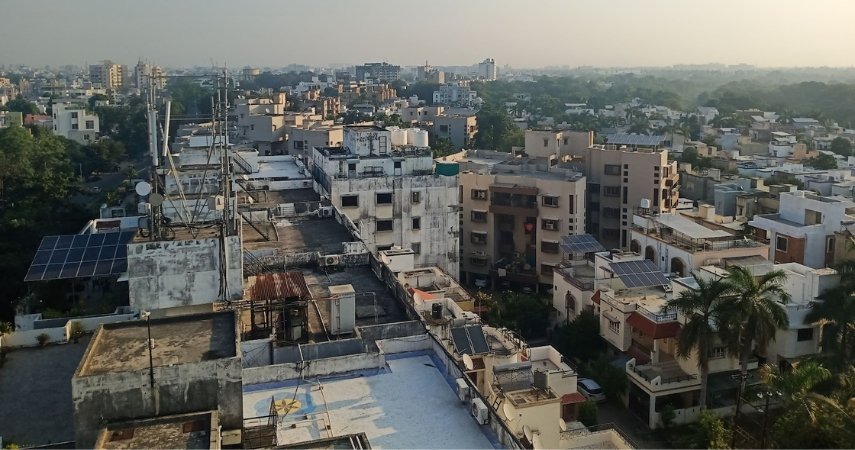
Vadodara’s compact layout — the city spans approximately 235 square kilometres — means that its major employment hubs, residential zones, hospitals, schools, and commercial centres sit in practical proximity to each other. L&T Knowledge City on NH-8, the pharmaceutical belt around Makarpura, the retail and dining corridors of Sayajigunj, and the educational density of the Fatehgunj-MSU zone are all accessible within 25–35 minutes from most residential neighbourhoods. Whether you live in Karelibaug or Vasna-Bhayli, the city does not punish you with a two-hour commute before your workday starts.
This is not a trivial advantage. Commute time is one of the strongest predictors of resident wellbeing in urban research. Cities that compress it create a daily dividend — in sleep, in family time, in mental bandwidth — that compounds meaningfully across a year.
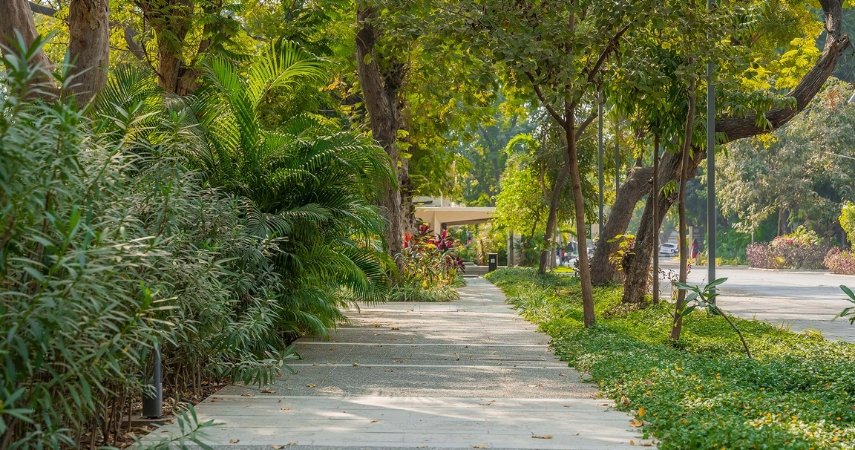
The city’s original identity — conceived by urban planner Sir Patrick Geddes as a city of gardens and lakes — has survived modernisation with more integrity than most Indian cities can claim. Vadodara maintains 42 lakes within its limits. Sayajibaug, stretching across 113 acres in the urban core, remains one of India’s most actively used public parks. Sursagar Lake at the heart of the city provides a rare urban water body that residents actually orient their evenings around.
The most consequential green project in Vadodara’s recent history, however, is the Vishwamitri Riverfront Development — a 24.5-kilometre intervention along the river that bisects the city. The project addresses the chronic monsoon flooding that has historically affected low-lying areas from Sama to Gorwa, while simultaneously converting neglected riverbanks into ecologically stable, publicly accessible green corridors. With dredging, embankment reinforcement, vegetation coverage, and biodiversity-sensitive design all factored in, this is not a cosmetic upgrade — it is a structural rethinking of how the city coexists with its primary waterway.
When complete, the Vishwamitri Riverfront will fundamentally change how residents in areas like Harni, Akota, and Waghodia Road experience their own neighbourhood. Green infrastructure of this scale is rare at the Tier-2 city level in India, and it positions Vadodara’s livability ceiling considerably higher than where it already sits.
Very few Indian cities can trace a direct, unbroken line between a 19th-century reform movement and a 21st-century educational ecosystem. Vadodara can.
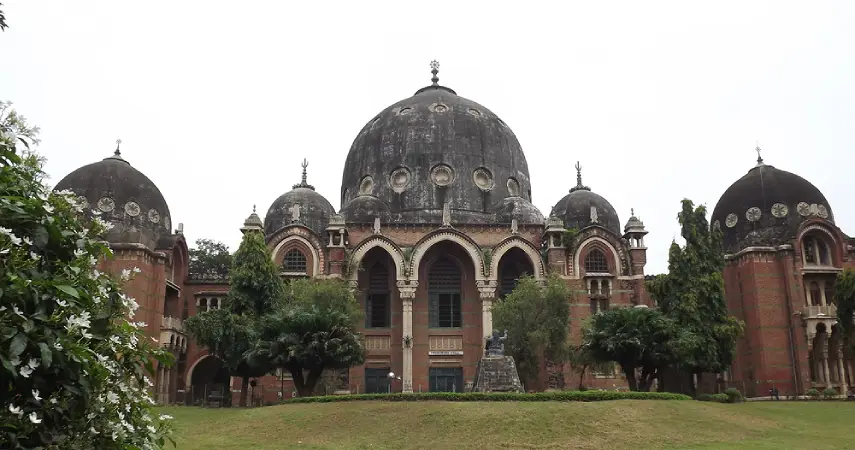
When Maharaja Sayajirao Gaekwad III made primary education free and compulsory in the Baroda State in 1906 — decades before independence, and well ahead of any national mandate — he planted an institutional value that outlasted his reign by more than a century. Today, that legacy expresses itself through the Maharaja Sayajirao University of Baroda, one of India’s most respected state universities, a dense grid of CBSE, ICSE, IB, and Cambridge schools distributed across every major locality from Gotri to Manjalpur to Karelibaug, and a growing cluster of professional and technical institutions that keep young talent anchored in the city rather than exporting it.
For families choosing where to raise children, Vadodara’s educational depth — at every price point, across every curriculum — is not a supporting feature. It is a primary draw.
A livable city does not just have excellent hospitals — it has hospitals that its residents can actually reach. Vadodara clears both bars.
SSG Hospital, one of Gujarat’s largest public tertiary care facilities, anchors the city’s healthcare system alongside GMERS Medical College and Hospital. The private sector adds a strong complementary layer — Sterling Hospitals, Baroda Heart Institute, Bankers Heart Institute, and a widening network of diagnostic centres and multispecialty clinics distributed across Subhanpura, Sama, Gotri, and Fatehgunj mean that no resident is ever far from qualified medical attention.
The pharmaceutical ecosystem that has made Vadodara Gujarat’s pharmacy hub reinforces this healthcare advantage in a practical, everyday way — reliable medicine availability, competitive pricing, and a deep pool of healthcare talent that chooses to practice here rather than migrate to metros.
In 2025, Gujarat celebrated two decades of focused urban development. Six cities were selected under the national Smart Cities Mission — Ahmedabad, Surat, Rajkot, Gandhinagar, Dahod, and Vadodara. Across these cities, over 357 projects worth more than ₹11,000 crore reached completion, covering integrated command centres, smart roads, digital governance, water supply upgrades, and public space redesign.
For Vadodara specifically, Smart City investments have gone into ICT infrastructure, urban mobility improvements, and the kind of civic technology that residents experience as smoother services rather than visible construction — faster complaint resolution, better-lit public spaces, digitised civic processes. The Gujarat State Budget for 2026-27 has allocated ₹33,504 crore to Urban Development and Housing, signalling that this momentum is not tapering. For a city already performing at Vadodara’s level, that sustained investment means the ceiling keeps rising.
Here is the quiet truth about livability that rankings rarely capture directly: it only matters if you can afford to live there.
Vadodara’s cost baseline remains one of its most decisive advantages. A well-located 2BHK in Karelibaug or Manjalpur rents for ₹10,000–₹18,000 per month. Premium addresses in Alkapuri and Sayajigunj command ₹18,000–₹28,000 — figures that represent extraordinary value against what the same rupees buy in Pune, Bengaluru, or anywhere in the Mumbai Metropolitan Region. Property purchase prices for a 1,000 sq ft apartment across mid-range localities fall between ₹45 lakh and ₹75 lakh, with steady but measured appreciation that rewards buyers without pricing out residents.
This affordability does not compress quality — it amplifies it. A family spending ₹70,000 a month in Vadodara lives materially better than the same family spending ₹1,10,000 in a comparable metro. The city charges less for the same access to schools, hospitals, parks, restaurants, and cultural life. That differential, compounded across years, is how ordinary families in Vadodara build wealth instead of just surviving.
Statistics measure a city. Culture defines it.
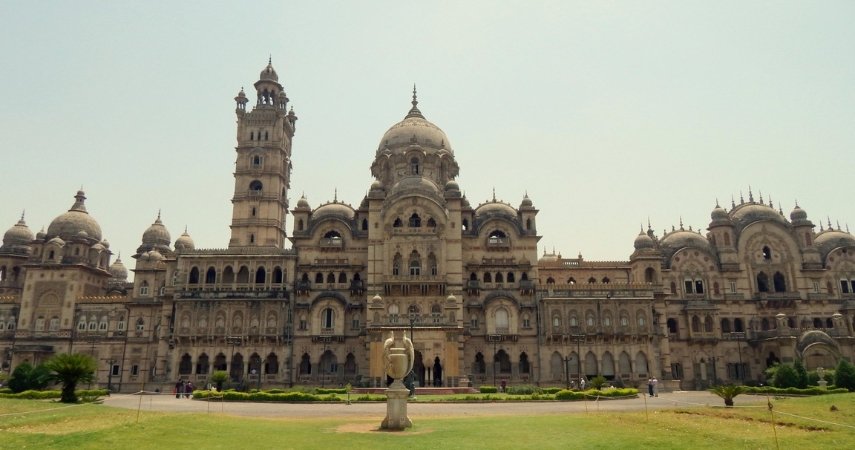
Vadodara’s identity — shaped by generations of Gaekwad patronage, Jain philosophy, classical arts, and civic pride — gives residents something that no infrastructure project can construct: a genuine sense of belonging. The city’s Navratri is not a tourism event. It is a community ritual, participated in by residents across every neighbourhood, from Akota to Ellora Park, from Fatehgunj lanes to the open grounds of Gotri. Its literary festivals, heritage temples, and arts institutions maintain a cultural pulse that makes the city feel alive in ways that real estate brochures never capture.
When people who have lived in Vadodara for a decade are asked why they never left, the answer is rarely one thing. It is the park they walk through every morning, the festival they look forward to every October, the neighbourhood they trust, the sense that the city they chose continues to choose them back.
Livability, at its best, is not a single spectacular feature — it is the discipline of getting many things right simultaneously, and the commitment to keep improving the rest. Vadodara’s rank in India’s Ease of Living Index is a reflection of that discipline. Its green spaces, educational depth, healthcare access, human-scale layout, affordable cost, and cultural richness do not exist in isolation — they reinforce each other, producing a quality of life that is consistent rather than conditional.
India has cities with louder skylines. Very few have Vadodara’s particular combination of daily calm, civic investment, and the kind of pride that makes residents genuinely glad they stayed.
There is far more to this city than any single blog can hold. The heritage behind its temples, the vision that shaped its streets, the industries that built its economy — every thread leads somewhere fascinating. Vadodara Rocks exists to follow those threads. Keep exploring.